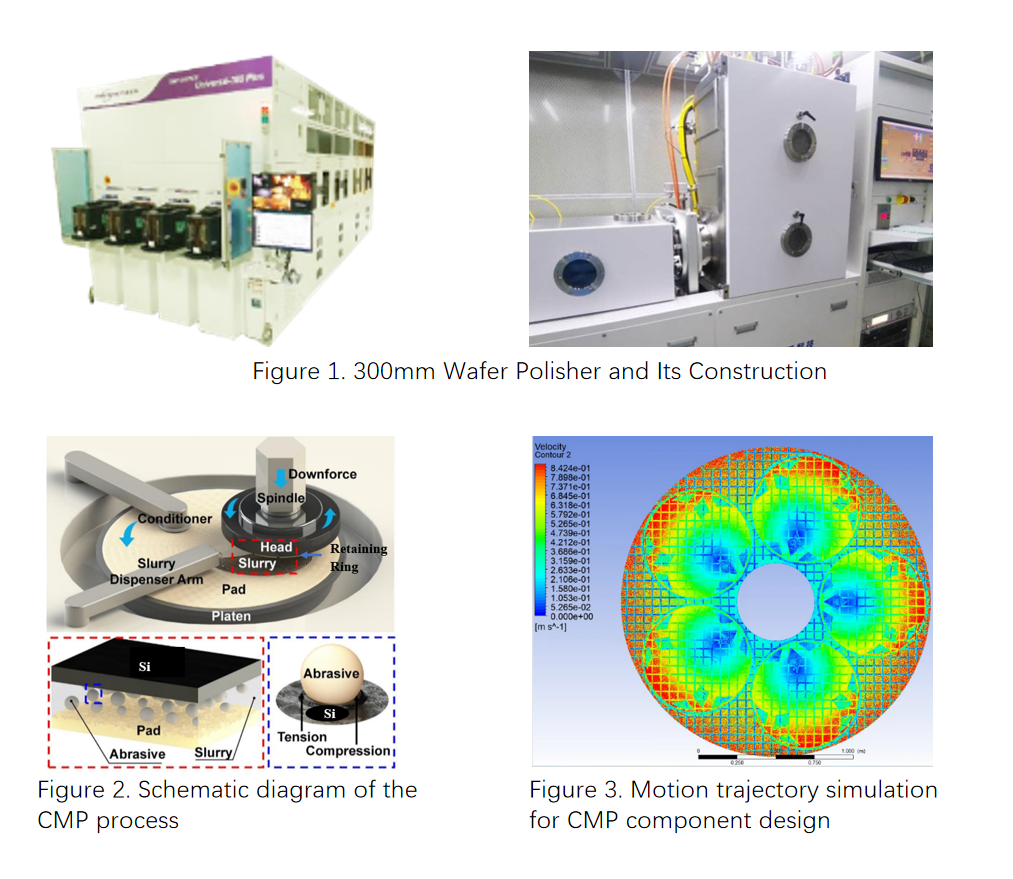
300mm Silicon Wafer Planarization
In semiconductor manufacturing, the continuously shrinking feature sizes impose increasingly stringent requirements on the surface planarity and smoothness of wafers and thin films. Chemical Mechanical Polishing (CMP) technology, capable of meeting wafer processing demands in terms of both machining performance and speed, currently stands as the only technique capable of achieving global planarization.
Our research group is dedicated to theoretical modeling and experimental studies of CMP processes and consumables. In the investigation of processes and consumables, we employ multi-physics coupled process simulation combined with AI technology to systematically analyze the interactions between processes, equipment, and materials during CMP. This approach enables us to optimize process flows and consumable designs, thereby improving both global and edge planarization. For polishing slurry formulation research, we leverage molecular dynamics and quantum chemistry simulations to deeply investigate and design slurry compositions, enhancing the overall performance of CMP processes.
The research outcomes of our group have established a solid theoretical and experimental foundation for improving the precision and efficiency of CMP technology, with some achievements already implemented by industry leaders.